[h3]
[/h3]
That was one of the most insane drafts -- perhaps the most insane -- of any of the nine with which I've been involved. Here's a quick take on which teams' fans should be happiest and which should be scratching their heads.
[h3]The Best [/h3]
The
Washington Nationals,
Pittsburgh Pirates and
Baltimore Orioles all took the best players available at their picks, and while they don't make a traditional "winners" list focusing on value relative to pick, each added an impact prospect to its organization and indicated a willingness to spend money to do so. The
Kansas City Royals were stuck in a spot where there was no clear best player available, but grabbed a player at a position of need in
Christian Colon, who was reasonable for the pick, will advance quickly, and will hopefully bring the
Yuniesky Betancourt era to a quick close.
The
San Diego Padres and
Milwaukee Brewers both took high school right-handers early, defying conventional (and, in my opinion, outdated) wisdom on the risk of that type of player, with San Diego landing one of the best pure arms in
Karsten Whitson, a right-hander with excellent arm speed and good command for his age. I like Milwaukee's pick of
Dylan Covey in the abstract, but if ever there was a team that needed to take a college arm, isn't it Milwaukee, with a withered rotation and no near-term help on the horizon?
I'm not a huge
Gary Brown fan -- his problems hitting with wood last summer concern me -- but that speed is a great fit for the giant outfield in San Francisco. His glove will likely justify the everyday job if he can hit enough to hold it.
The
Cincinnati Reds got a small gift when
Yasmani Grandal -- whom I had connected to them in a mock draft two weeks ago -- fell to them with the 12th pick; even with Devin Mesoraco's sudden breakout this year, Grandal was the best player available to the Reds, and in the event that both guys pan out, one of them will become a tremendous trade asset for the club.
I can't get over the
St. Louis Cardinals' good fortune -- and fortitude -- in landing
Zack Cox and
Tyrell Jenkins with their first and third picks of Day 1. Cox was sixth on my board, the most advanced college hitter in the draft this year with outstanding performance in Division I's best conference, and I like his chances to stay at third base in the long term. Jenkins is a high-projection right-handed pitcher who is among the best overall athletes in this draft and who doesn't need the major delivery work that most such prospects require. In between, the Cardinals took a safe college pitcher in
Seth Blair, who could end up a No. 3 starter in a best-case scenario.
[h4]Pick-by-pick analysis [/h4]
Jason A. Churchill and Keith Law analyzed virtually every pick of MLB draft 2010's first day in the MLB draft blog. Find your team's evaluation within.
The draft blog
The
Boston Red Sox took advantage of falling guys as well, landing my No. 10,
Bryce Brentz, in the sandwich round. Conventional wisdom on Brentz's struggles this year was that he got a little draft-itis, trying to hit for power at the expense of his overall hit tool, but whatever the reason, he came out of last summer as a likely top-10 pick and the Red Sox were wise to remember that. Similarly, they popped preseason No. 2 prospect
Anthony Ranaudo in the sandwich round, and they'll have time now to get comfortable with the state of his elbow before committing what would likely be a top-five-overall bonus if they sign him. At No. 20, they took
Kolbrin Vitek, an athletic college hitter with some risk -- he needs to move to the outfield and we don't have wood bat looks at him from past summers -- but the potential upside of an above-average glove in center who provides value with the bat.
The
Los Angeles Angels had a slew of picks, and they stuck to their philosophy with high-ceiling prep players, landing a power-hitting third baseman in
Kaleb Cowart; a right-hander with a chance for two plus pitches in the near future in
Cam Bedrosian; and one of my favorite swings in the draft in
Taylor Lindsey.
Chevez Clarke strikes me as the high school analogue to Brentz, a player who was seen as a first-rounder last summer who slipped due to an off spring. The only pick here I didn't love was
Ryan Bolden, an incredibly toolsy outfielder from Mississippi with a 30 present hit tool.
[h3]The Head-Scratchers [/h3]
I was stunned when I heard the
Chicago Cubs' selection,
Hayden Simpson, a diminutive pitcher from Division II who has two average pitches and good command and control, in Round 1. For one thing, it's not scouting director Tim Wilken's style; he loves athletes and hard throwers, guys with upside who have the chance to become stars. For another, I can't imagine Simpson wouldn't have been there for the Cubs' second pick; other teams told me they had him in the fourth or fifth round, or not in their top 200, or that he was "not a priority guy."
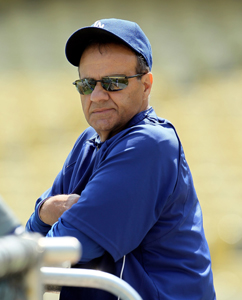
Getty ImagesA desire to play football for Les Miles may keep Zach Lee away from Joe Torre and the Los Angeles Dodgers.
The
Los Angeles Dodgers took
Zach Lee, described by one draft-room source of mine as "the most unsignable player in the draft," and I've spoken to several other sources who speculated that they may have taken him knowing they couldn't sign him with the intention of getting the compensatory pick next year when, they hope, they have more money to spend in the draft. Lee has spurned inquiries from several teams and indicated that he'd prefer to go to LSU to play football, although if he does sign, the Dodgers have perhaps the best athlete among pitchers in this draft, a right-hander with an excellent delivery and a chance for three above-average pitches.
The
New York Yankees also drew some surprised reactions by taking prep shortstop
Cito Culver in the first round -- I was doubly confused when he was listed on MLB.com as a right-handed pitcher -- when the Northeast area scouts were telling me all spring he was a third-or fourth-rounder. The Yankees see Culver as a shortstop with a chance to hit for average and some power, and he has a plus arm, but there are mixed opinions on whether or not he's going to stay at short. On the flip side, the Yankees had Culver on their Area Code Games team last summer and probably knew him as a player and as a person better than any other team could have.
[h3]The Best Players Still Available [/h3]
Outfielder
Austin Wilson (No. 22), shortstop (to be third baseman)
Kris Bryant (No. 29); first baseman
Austin Wates (No. 24), and pitchers
James Paxton (No. 21),
Brandon Workman (No. 22),
A.J. Cole (No. 25), and
Stetson Allie (No. 27) are all still available from my top 30. Wates faces positional questions but has one of the better swings among college bats in this draft. Workman's fall is still something of a mystery. Paxton wasn't as impressive in indie ball as scouts had expected. The rest are all big-ticket high school players looking for outsized bonuses or, in Wilson's case, expressing clear commitments to college.
Analysis: Manny Machado to the Orioles